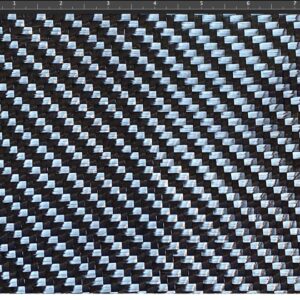
The carbon fibre reinforcements listed on these page cover a broad range of applications. These centre on moulding, skinning, repairs, general laminating and the fabrication of forged parts.
Application usage involves hand lay-up, resin transfer moulding, vacuum bag infusion and autoclaving.
Carbon fibre fabric
Carbon fibre fabric exists in a range of weaves, tow sizes, thicknesses and width.
They are used for a variety of applications. A commonly used example is 200 g 2/2 twill 3k carbon fibre fabric.
Spread tow carbon fibre
Spread tow is a carbon fibre fabric that is manufactured to make individual tows of carbon fibre broad and flat. This generates fabrics which are smooth flat and free from the uneven texture apparent on woven versions. The flat and non-woven design generates an increase in stiffness and a more consistent finish. These fabrics can be used in lay-ups where a conventional woven design is present to give a flatter finish.
Multiaxial (NCF) carbon fibre
Multiaxials are comprised of aligned layers of unidirectional carbon fibres. These fibres are inherently straighter than their woven counterparts. This makes them stiffer under tension. They often utilise 45 degree angles (+/-) and are therefore favoured in composites as simpler way to achieve fibre orientation and thus strength.
These types of fibres can be paired up with conventional woven carbon fibre fabrics to achieve laminates quasi-isotropic orientation.
Unidirectional carbon fibre
Unidirectional reinforcements create composites that present the carbon fibres in the same direction. This creates a very specific advantage, in the the composite can be lightweight and very strong in a single targeted direction, but also disadvantage in that they are weaker in other directions. Cross-stitching and binders may be used to ensure that form is maintained.
Unidirectional carbon fibre reinforcements are compatible with a variety of laminating processes, such as hand lay-up, vacuum bags and resin transfer moulding.
Non-woven (forged) carbon fibre
Non-woven carbon fibre represents a newer form of reinforcement.
These chopped carbon fibres may be freshly processed or recycled from previously used carbon fibre composites. These fibres are mixed with an appropriate amount of epoxy resin prior to creating moulded parts which are both aesthetically pleasing and versatile.
Prepreg carbon fibre
Prepreg carbon fibre is a term used to describe carbon fibre fabric which has been pre-impgrenated with resin, typically epoxy. It already includes a curing agent and so can be laid directly onto the mould surface.
Prepreg avoids the need to prepare the resin-hardener mixture, but is more expensive, has a shorter shelf life and requires cold storage.