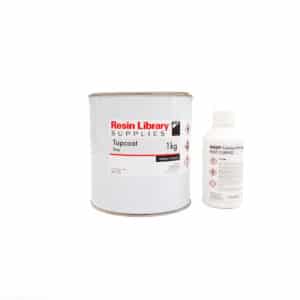
Fibreglass resins are more commonly referred to as polyester resins. When combined with glass fibre reinforcements they create fibreglass.
Fibreglass resins are usually combined with glass fibre chopped strand matting to create flat roofs, pond linings through to flat roofing projects and more general fibreglassing work. Polyester resin topcoat is also included to further protect the fibreglass laminate and for aesthetic purposes.
Fibreglass resins come in sizes ranging from 1 kg to 20 kg and each tin comes with sufficient MEKP catalyst.
Each product type contains a more detailed description with recommended instructions and applications and safety considerations. Video instructions are also available for certain applications. Note: polyester resin and polyester topcoats require MEKP catalyst addition to harden. An absence of catalyst – or an incorrect amount – will mean the laminate will not harden, compromising its integrity.
Fibreglass resins can be used with glass fibre reinforcement to create linings, coatings and mouldings. Each of these offers excellent waterproofing, durability and aesthetics.
Fibreglass resin listed here are typically used to create new fibreglass roofs and make repairs to existing ones, create pond and water feature linings and provide more general waterproofing and mechanical protection to concrete, timber and other porous substrates
These resins are sold separately, but glass fibre CSM and fibreglass kits are available for more specific projects such as pond lining, fibreglass roof installation and roof repair.
Compatible with timber decking, existing fibreglass (GRP), concrete and other adequately prepared surfaces.
Note: a resin primer is strongly recommended for surfaces like concrete, which could be affected by water ingress, or plywood, which could see limited adhesion.
Fibreglassing itself requires a degree of planning, preparation and skill to ensure a quality finish.
Step-by-step instructions on how to use each kit. Fibreglassing tutorials for respective applications are also available. Technical support is also available by email or telephone.
What type of resin is polyester?
Fibreglass polyester resin is a thermoset resin. This means it is designed to chemically react to form a three-dimensional network. Thermosetting resins are a class of resin that include unsaturated polyester, vinyl ester, epoxy, and polyurethane resins. Additives used in combination are typically referred to as hardeners, curing agents, peroxide initiators, isocyanates, fillers, and flexibilizers.
Polyester resin curing
Thermosetting resins like polyester are typically low-viscosity liquids or low-molecular-weight solids that need additives such as cross-linking agents to be formulated and cured. For polyester resin, the curing process can be activated by a catalyst, typically methyl ethyl ketone peroxide (MEKP), but can also be driven by heat and pressure. This causes the resin to polymerize and harden via an exothermic reaction, with the process completing when polymer molecules have cross-linked. The individual molecules can form covalent bonds, which ultimately leads to a single, giant molecule. This process is a result of the molecular arrangement to a lower energy state compared to the random orientation of the liquid. Unlike thermoplastics, thermoset resins cannot be melted through re-heating once cured.
Fibreglass itself is one of the most widely used materials in the global composites market and its qualities of fibreglass can be utilised for a range of applications requiring mechanical strength and durability in the form of good tensile and flexural properties, excellent abrasion resistance, waterproofing and broad chemical resistance.