


Aim
Repair and refurbish the outside surface of a fibreglass water tank.
Background
A potable water storage tank was refurbished due to its poor condition. Water tank replacements are expensive – particularly for larger repairs. Making repairs to existing storage tanks is a much more cost-effective procedure.
The inside of the water tank was in good condition, but the outside had been subjected to physical stressors, which had caused delamination, cracks and holes to occur. This damage had been further compounded by excessive movement and impact over a period of several years.
A refurbishment of the storage tank was therefore decided. The focus of this was to be on the application of glass fibre-based repairs.
Materials & Tools
A foam filler was used to fill the damaged holes and cracks in the structure. Sandpaper was used to prepare the surface. Resin Library Acetone was used to clean the surface once prepared. A stanley knife was used to cut the excess foam and fragments back.
A 5 m2 Resin Library fibreglass repair kit was used to implement the repairs. A 600 gram CSM grade was used for reinforcement. 2.5 litres of Resin Library topcoat (flowcoat) was used to coat the laminate.
 Fibreglass Repair Kit
 Fibreglass Repair Kit
Versatile and seamless, fibreglass is an excellent repair system able to provide a high level of mechanical strength.
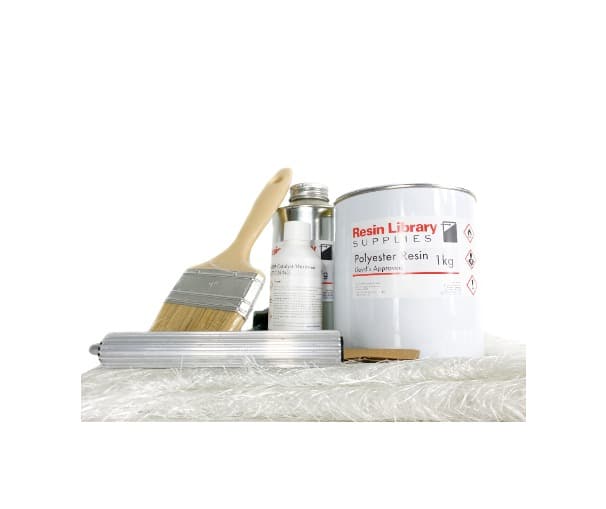
A polyester roller and 6-inch paddle roller were used for laminating and consolidating the laminate respectively. A 3-inch brush was used to laminate more complex regions. These were present in the repair kit.
Method
1. Drain water and allow it to dry out. Invert the storage tank to present the physical damage, making it easier to perform a repair assessment.
2. Identify cracks and holes in the storage tank and insert a filler to add structure to the fibreglass structure. In this example, a standard foam was injected that matched the foam inside the tank. Allow this to harden (approximately 60 minutes) and cut back excess pieces and sand back.
3. Wipe the surfaces away using an acetone soaked cloth. This is to ensure the laminate repairs bond strongly to the structure; surface contamination interferes with curing.
4. Pre-cut glass fibre chopped strand matting (CSM) to sections amenable to the repair area(s).
Note: small sections and strips were initially used to cover the repair areas first. Additional larger areas were used to cover these smaller regions if more extensive damage had occurred.
5. Prepare workable quantities of polyester resin by adding MEKP catalyst to the polyester resin.
Note: A concentration of 1 – 4 % volume of catalyst to weight of resin is recommended. This means 10 – 40 mL of MEKP per 1 kilogram of polyester resin.
Note: 1 – 2 kg of catalysed resin is considered workable in most instances. It is advisable to work with smaller quantities for repairs. Catalysed resin has a 15-20 minute timeframe before it begins to cure.
6. Saturate the glass fibre matting in catalysed polyester resin. This should be equivalent to 1.5 – 1.7 kg per square metre and up to 2 kg per square metre.
7. Once in place, drive the resin into the laminate using a polyester roller and/or paintbrush for smaller regions. Use a paddle roller to consolidate the laminate. Once applied, allow to cure for 2 hours or until hardened.
8. Prepare workable quantities of topcoat resin by adding MEKP catalyst to the polyester resin.
Note: A concentration of 1 – 4 % volume of catalyst to weight of topcoat is recommended. This means 10 – 40 mL of MEKP per 1 kilogram of polyester resin. Mixing is important here – be more thorough in mixing the topcoat due to its viscosity.
Note: 1 – 2 kg of catalysed topcoat is considered workable in most instances. It is advisable to work with smaller quantities for repairs. Catalysed resin has a 15-20 minute timeframe before it begins to cure.
9. Apply the topcoat resin to the laminate, aiming for a 0.5 kg per square metre coverage. Use a standard roller (a paddle roller should not be used here). Allow to cure for 24 hours until usage.
10. Inspect the water tank repaired regions. Consider a visual check (exposed fibres, cracks, pinholes, etc.) and rectify as needed. Also, consider an audible check (knock on the laminate to check for defective non-solid sounds). Finally, fill the water tank and determine the extent (if any) of any leaks.
Conclusions
Once the laminate had cured, the topcoat was applied. This provided a sleek, seamless, abrasion-resistant and durable finish to the storage tank. Given the durability of fibreglass composites, this storage tank can have an expected lifespan well in excess of 20 years.