
Calculators Learn more

Fibreglass (GRP) Flat Roofing Kit (600g)

Fibreglass is an excellent flat roofing material that has established itself as a robust and reliable option over several decades. As a composite – a blend of polyester resin and glass fibre chopped strand matting – it enables the creation of a strong, lightweight and seamless waterproof and chemically resistant barrier. Notably better performing and safer to install than other membranes, like rubber and felt, it is a preferred option for many users.

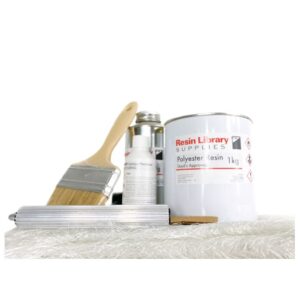
Each kit comes with the necessary materials and tools (optional) needed to build a fibreglass flat roof.

Price range: £150.00 through £1,239.00

Send to a Friend

Description

Resin Library’s fibreglass flat roofing kit is available in a range of sizes.

Each kit size can be selected from the dropdown menu.

UV stable and manufactured in an ISO9001-compliant facility, the polyester resin is a reliable, proven brand suitable for both indoor and outdoor applications. Our polyester resin is also Lloyd’s approved and WRAS compliant.

Tips: ensure adequate surface preparation has been performed in advance.

Polyester resin catalyst (MEKP) is included.

A resin primer (purchased separately) is strongly recommended to improve laminate adhesion and to prevent external contaminants from entering the pond.

Fibreglass flat roofing kit Product Description

Each kit uses 600-gram CSM to ensure a simple yet durable and highly fibreglass flat roof.

Fibreglass is a composite material – a blend of polyester resin and glass fibre chopped strand matting with extensive application in the marine industry. Used correctly, cured fibreglass will create a strong, lightweight and seamless flat roof coating able to keep heavy rainwater out.

What is in the kit?

Key ingredients

Each kit comes with the necessary materials and tools (optional) needed to create a fibreglass roof.

The polyester resin is UV stable, WRAS compliant and manufactured in an ISO9001 compliant facility. It is a reliable, proven brand suitable for both indoor and outdoor applications. Glass fibre chopped strand matting is 600 g. The polyester resin is standard grey and offers an excellent finish. MEKP catalyst is required for resin curing and an appropriate quantity is supplied with each kit.

Applications

Fibreglass is an outstanding flat roofing system with excellent long-term durability. It adheres well to a range of substrates, from existing fibreglass to wood (e.g., timber decking and plywood) steel and concrete.

Take care to ensure that adequate surface preparation has been undertaken in advance and that a suitable substrate has been laid. OSB3 timber decking is highly recommended.

A seamless, durable and waterproof barrier that bonds well to a variety of substrates, it also has a high strength-to-weight ratio and the ability to be moulded into almost any shape, fibreglass makes an excellent repair system.

Recommended flat roofing projects are listed below:

+ New flat roofs – for garages, home extensions, apartments, orangeries, sheds and more.

+ Flat roof overlays

+ Flat roof overdecks

+ Flat roof repairs

Guides

Creating a durable fibreglass flat roof requires a degree of skill, care and attention. Please see the download section for more detailed information.

Users should ensure the existing surface and underlying structure have been dried out, is free from contaminants (dust, debris and grease) and is clean.

Our instructional step-by-step guides cover a wide range of topics and exist in both written and video formats on fibreglass repairs. Technical support is also available for more bespoke applications.

More specific information can be found in the Technical Datasheets for respective products, as well as on individual product pages for polyester resin, glass fibre matting and MEKP catalyst.

Key Processing Information

Fibreglass flat roofing kits should be stored in a cool, dry place away from sunlight.

Surface preparation is a critical step in creating a high-quality fibreglass laminate. Applicators should ensure the surface has been sufficiently dried, cleaned and rendered to maximise adhesion.

A G4 primer (optional) is recommended in certain repairs where ongoing dampness or poor adhesion is expected.

Users should ensure the surrounding atmosphere and any surfaces the fibreglass laminate is applied to should be clean, dry and free of contaminants (dust, grease, moisture, debris, mould, etc.). More detailed instructions on how to install a fibreglass flat roof can be found in our step-by-step guide.

More specific product information can be found in the Technical Datasheets for each product, as well as on individual product pages for polyester resin, glass fibre matting, resin topcoat and MEKP catalyst.

  • Suitability: professional laminating, DIY and hobby usage
  • Safety Precautions
    • Wear PPE: gloves, goggles and if working with resin, a mask unless working in a well-ventilated area. Use protective gloves when handling.
    • Read the MSDS in advance and plan ahead.
  • Recommended working conditions: dry, ambient conditions (15 – 30 °C)
  • Can be used from 15 to 30°C provided the atmosphere and surfaces are dry
  • Resin-600 gram CSM ratio: prepare 1.5 – 1.7 kg of catalysed polyester resin prior to application.

Application

  • Measure the dimensions of the area for coverage in advance. Cut to size using a stanley knife. Glass fibre  CSM should be 10% above the desired surface area to accommodate trimming and ensure complete coverage.

Storage

  • Unopened shelf-life 6 months.
  • Store at 2 – 20 oC in a clean, dark environment sealed inside an air-tight bag.
  • Avoid moisture and other contaminants (liquids and particulates).
  • Once opened, immediately seal after use. Use within 3 months

Safety

Quality

Resin Library’s Lloyd’s-approved polyester resin is manufactured in an ISO9001-compliant environment. It is used by leading fibreglass roofing brands and is a high-performance ingredient in many fibreglass applications.

Education

In addition to guides and articles available in Resin library’s Knowledge Centre, a range of courses are available in composite production (relevant to fibreglassing methods), to apprenticeships in roofing and material science degrees. In some of these, grants are available for women in construction.

Downloads

Specification Document

Fibreglass Roof Specification

Manuals

1-5 Health and Safety in Fibreglass Roofing

2-5 Fibreglass Roofing – Edge Trim Installation

3-5 Fibreglass Roofing – Timber Decking & Insulation Installation

4-5 Fibreglass Roofing – Laminating

5-5 Fibreglass Roofing – Topcoat Application

Technical & Safety Data Sheets

Technical Data Sheet – Unsaturated polyester resin

Acetone TDS & MSDS

MEKP

Polyester resin MSDS

Topcoat

FAQs

Q. Do GRP roofs crack?

A. If correctly installed, fibreglass roofs should not crack. Reasons for ‘cracking’ are attributed to poor quality materials and incorrect installation. Resin Library offers both video and written guides on how to install a fibreglass roof effectively.

Q. What fibreglass resins are included in the kit?

A. Polyester-based resins are included. The first is a laminating one for the chopped strand matting and the second (topcoat) is a dark grey flexible resin. These are industry standard for almost all GRP roofing applcations.

Q. Can you walk on a 600 gram CSM fibreglass roof?

A. Yes, the 600 gram CSM fibreglass roof kit sold here will be able to accommodate moderate foot traffic. This means occasional window cleaners, gutter cleaners and workmen can operate on the roof. We would recommend a dual layer if ‘heavy’ foot traffic is expected like that on a balcony, walkway or terrace. 

Q. What is the expected lifetime of a fibreglass roof?

A. 30+ years is the expected lifetime of a standard fibreglass roof, with many extending beyond that. 

Q. Can I add fibreglass onto an existing fibreglass roof?

A. Yes, this could be achieved if the underlying structure has not become exposed to damp or moisture from a leak. 

Q. What is the difference between the terms ‘fibreglass’ and ‘GRP’?

A. Fibreglass refers to the composite material made from resin and matting. GRP is largely the same thing and is short for ‘glass reinforced plastic’. Additionally, the United States may use the term ‘fiberglass’ and ‘FRP’ (short for fibre-reinforced plastic). 

Q. How can I calculate my roof size?

A. You could use Google Earth to estimate the surface area or if your roof is safe, then you could use a measuring tape. 

Standard methods to calculate the size of a roof centre on multiplying the length by the diameter of the roof. Usually calculated in meters, this would give a ‘square meter’ result, equating to the surface area.

The size of the roof can be used to determine the size of the fibreglass roof kit needed. Resin Library have an online calculator to assist if needed.

Q. Where can I get instructions on how to build a fibreglass flat roof?

A. In the download’s section of this page, Resin Library provides instructions on how to install the timber decking, laminate and apply the resin topcoat.

Q. How many layers of fibreglass are needed to build a flat roof?

A. One layer of fibreglass matting is needed to build a fibreglass roof, with the exception being if heavy foot traffic and equipment placement is expected then two layers are recommended. 

Q. Can you fibreglass onto a felt roof?

A. Not directly – you would need to scale back the existing felt – or alternatively install timber decking onto the existing roof and laminate on top. A sealant would also be needed to ensure the roof is watertight. 

Direct application to felt is not advised; GRP roofing requires good adhesion between layers and a laminate-felt bond could be quite weak.

Consideration in regards to edge trim placement is also recommended and decisions should be made on a case-by-case basis.

Q. What planning permission is needed to build a flat roof?

A. Any form of roof adjustment or modification may come under planning regulations. 

A key aim of these regulations – particularly to existing roofing structures – is to make the owner upgrade the insulation. This is required if more than 25% of the roof is being stripped up and replaced. 

Planning portal topics on flat roofing and Part L Building Regulations should be consulted.

Q. Why use 600 gram CSM over 450 gram CSM for a fibreglass roof?

A. 600 gram matting creates a thicker more durable laminate compared to 450 gram CSM, which is thinner and less robust. 

Videos

Additional information

Size

5 m2, 10 m2, 15 m2, 20 m2, 25 m2, 30 m2, 35 m2, 40 m2, 45 m2, 50 m2